
The Dim Sum Gang is a dark graphic novel that uses the anthropomorphized perspective of pieces of dim sum to critique the profession of Dumpling Hunting and advance a raw food agenda. The story begins with the origin story of a Xiao Long Bao’s awakening consciousness as it is assembled from dough, soup and pork filling and then steamed. Bao’s happiness in the warm steamer basket is short lived as it sees its companions snatched away by swooping, diving chop sticks. With the help of two pieces of Stinky Tofu co-joined on a skewer, Bao makes its escape and begins its journey across a landscape of Chinese banquet tables littered with steamer baskets. Along the way Bao meets a cast of dim sum characters, such as Sticky Rice and Chicken Foot and the Queen of the banquet, Peking Duck. The journey leads up to a battle royal between two Sesame Balls, in which sesame seeds fly like throwing stars in an issue of Frank Miller’s Daredevil or Neal Adams’ Armor. Throughout the journey Stinky Tofu acts as the story’s Greek chorus and reader’s acerbic guide to the world of Dim Sum. One wonders whether Stinky Tofu is a reference to Yuen King-Tan’s Abacus Fong character in Michelle Yeoh’s classic 1994 film Wing Chun.
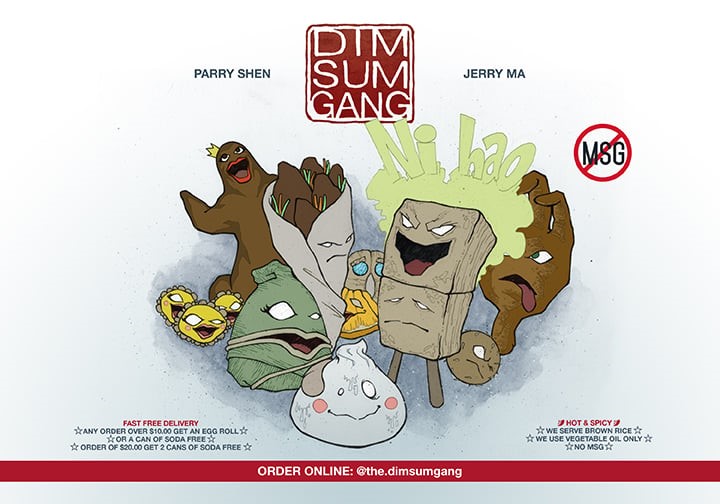
While the story could superficially be read as the finding of family or community through the adversities of a hero’s journey narrative, the Dim Sum Gang is actually both a woke polemic demonizing food bloggers and social media food influencers and sly, but confusing, propaganda for the raw food movement. While food bloggers are largely relegated to the gutters around the frames, the only in-frame illustration of a food blogger is of a hapless newbie experiencing the face burn of biting directly into a Xiao Long Bao. Nowhere in the story are the cultural and social contributions of the food blogger depicted, nor the job creation benefits to society, or the hardships and health risk of excess eating faced by the food blogger. The scene in which Bao is able to hide beneath Stinky Tofu, because no one wants to touch Stinky Tofu, is ridiculous. No self-respecting food blogger would turn away from Stinky Tofu, like the obvious metaphor to Abacus Fong, Stinky Tofu has a soft interior beneath its harsh aggressive façade.
The notion that Bao gains sentience and begins its hero’s journey through the process of being assembled and steamed reveals the author’s extreme pro-raw food agenda. Clearly the authors are saying that only raw unprocessed foods can be ethically consumed by food bloggers. Since it is impossible to eat an unassembled dumpling, the story attempts to single out Dumpling Hunting as inherently wrong. But the slaying of one vegan sesame ball by another in the final Ninja throwing star/seed fight scene calls into question whether the authors are trying to indoctrinate the reader into full on raw food veganism. After all, on the pen-ultimate page the sesame ball cries “Are you not entertained?!” As such the authors appear to subvert their original pro-raw food vegan message, leaving this reader ultimately confused. The authors acknowledge this contradiction in the final frame with Stinky Tofu saying “Seriously – what the Hell just happened?” (perhaps alluding to the final battle in Wing Chun). This final panel lets the average reader off the hook, leaving only the Dumpling Hunter as the target of the author’s sharp barbs.
The Dim Sum Gang was drawn by Jerry Ma and written by Parry Shen. I drank some Scotch with Jerry at the NY Comic Con and he gifted me a copy of the Dim Sung Gang. He has created art for the NY Mets and the NY Asian Film Festival and published the excellent “Monkey King” graphic novel. His work can be seen and purchased at the Epic Proportions website; buy Dim Sum Gang there. I am the very happy owner of several pieces of Jerry’s original art.

 The search for the world's best dumplings